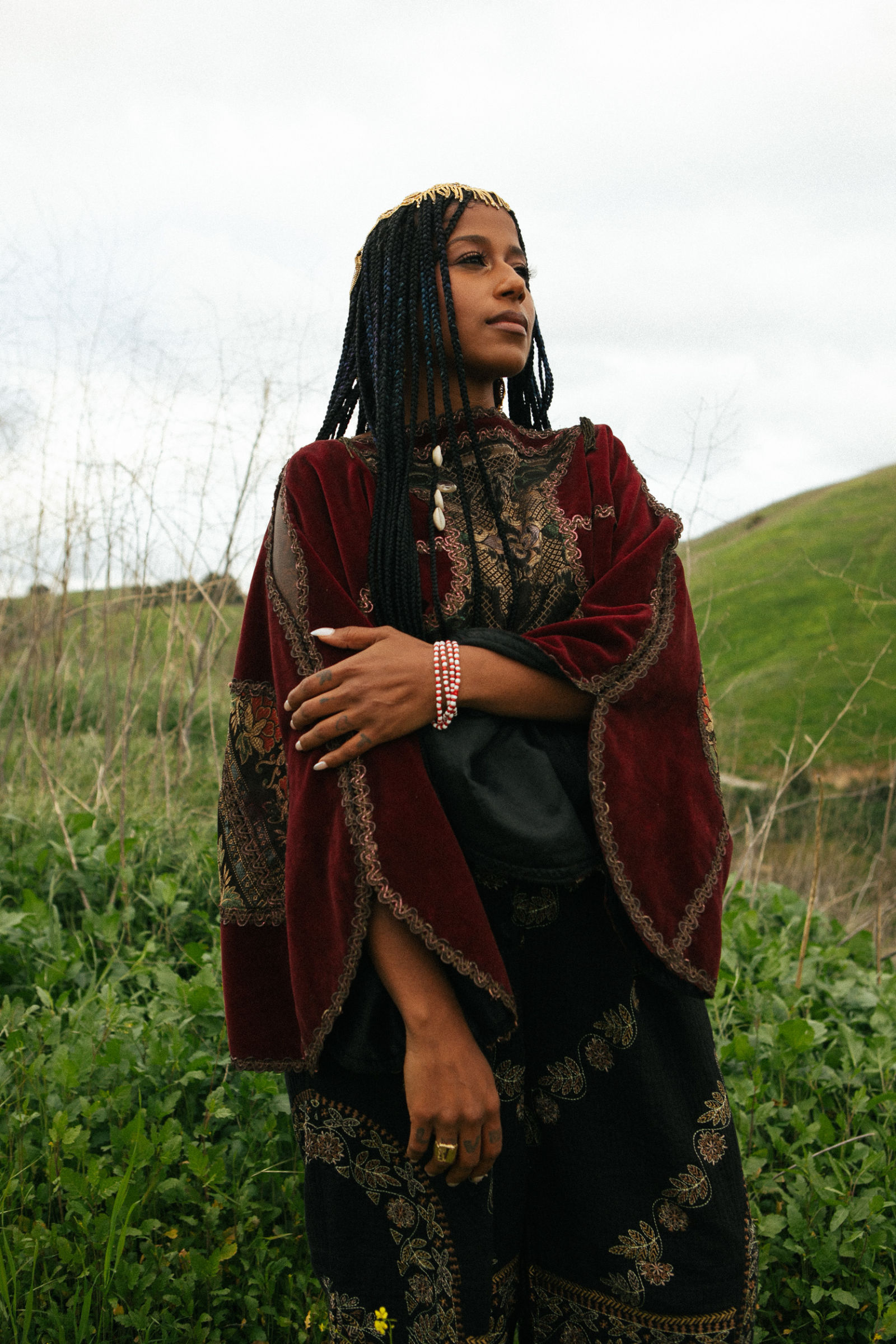
aja monet
FollowBrooklyn, NY
About
aja monet’s poems are a work of gravity. They are a fundamental for which all things are attracted,
considered upon and enacted towards. Her work moves, constantly, between origin and outcome, allowing
them to exist in converse. In her debut album when the poems do what they do, we glimpse her
indefatigable commitment to speak. Those thematic origins of this album at times center around Black
resistance, love and the inexhaustible quest for joy.
As a community organizer, surrealist blues poet and teacher aja monet moves between mediums, each one
an element to her writing. Here, organizing and activism aren’t the point, they’re the process. The endgame
is liberation and the poems, the music, and the art serve as the scribe of the time. Building off a tradition
rooted in oratorical facility aja is the conduit for her predecessors to channel through. At any given time
you’ll find the revolutionary spirit of Audre Lorde and the Last Poets, you’ll feel June Jordan, Amiri Baraka,
Jayne Cortez and even the expressive ephemerality of a passing blue note. All appearing as generational
trees from which these poems fruit.
aja monet has been a poet in name since before birth. In her 2017 debut collection of poems my mother
was a freedom fighter, she outlines in give my regards to Brooklyn, “i owe my life/to the woman/who
stopped my mother/on the b56/on her way/to the abortion clinic/and told her/ you have a poet coming.” She
has been a poet in verb since youth, “I started writing when I was 8 or 9 — [but] I think I was a poet before I
wrote my first poem.” She matriculated in writing upon enrolling in Baruch College Campus High School
and then in joining Urban World NYC. She cut her teeth within the walls of the legendary Nuyorican Poets
Café, where she won the title of Grand Slam Champion in 2007 at age 19, making her the youngest Grand
Slam Champion in the venue’s history.
She grew up in Brooklyn, where the incessant harassment of the Black community by way of the police was
an untenable growing pain. Here in between the raucous and propulsive insistence of rap and the
predetermined experience of Black people in America she learned to navigate language. After graduating
from Sarah Lawrence College and the School of the Art Institute of Chicago, and living briefly in Paris, aja
monet co-edited Chorus: A Literary Mixtape alongside poet-actor-director Saul Williams and released two
chapbooks of poetry The Black Unicorn Sings and Inner-City Cyborgs and Ciphers. Throughout her
journeys, her poems always have a way of pointing back to home - aware and paying homage to from
whence she came.
In when the poems do what they do aja monet appears as a woman of letters and storm, her poems do not
roar in pentameter - but rather in storm surge because, “Who’s got time for poems when the world is on
fire?!.” And this work isn’t one to pull apart into one liners, these are poems of things felt. There is a fullness
here that can’t be encapsulated in even the boundaries that language offers. aja monet is a griot, a storyteller,
a chronicler, and your grandmother telling you about her first love all at once. These are baby making poems
- literally the spring enacting upon the cherry trees. These are poems of urgency and want and the rallying
cry to demolish the insidious systems from which our futures seem to be wrought, in other words,“If we had
a sense of humor we’d be more radical. More migrant than citizen we’d breathe the air clean and ration our
resources...we would melt ALL the guns.” You will find yourself readying arms because of these poems, and
simultaneously mourning the unstoppable loss of names already destined to be immortalized. aja monet
crafts a work as she always does, that can be entered from many doors. These aren’t poems for poets, but
poems for everyone.
She is joined in effort on this album by musicians Christian Scott (trumpet), Samora Pinderhughes (piano),
Elena Pinderhughes (flute), Luques Curtis (bass), Weedie Braimah (djembe) and Marcus Gilmore (drums).
Together creating music that is insistent and unrelenting. There are songs reminiscent of jazz club virtuosity
and melee, others of a healing balm in gilead, and the chords of Castaway move like that of the call to
intercessory prayer. When you finally reach the end of this album, you are left with a similar feeling you get when heartbroken,
the gravity of barrelling back down to earth, sopping wet with tears, out of breath, overcome with love,
despair, hope, and all too aware that all of this, is over far too soon. When the poems do what they do, they
do absolutely everything.