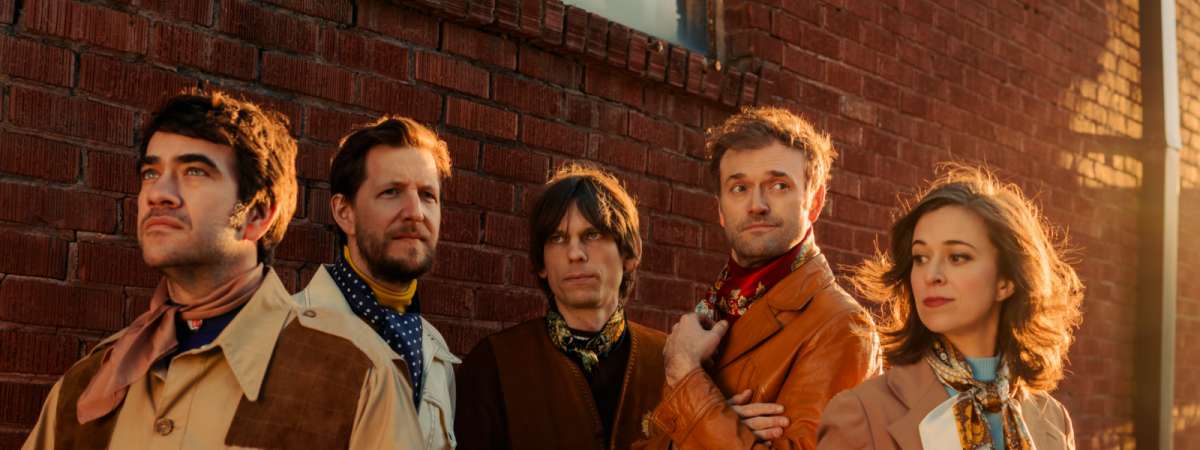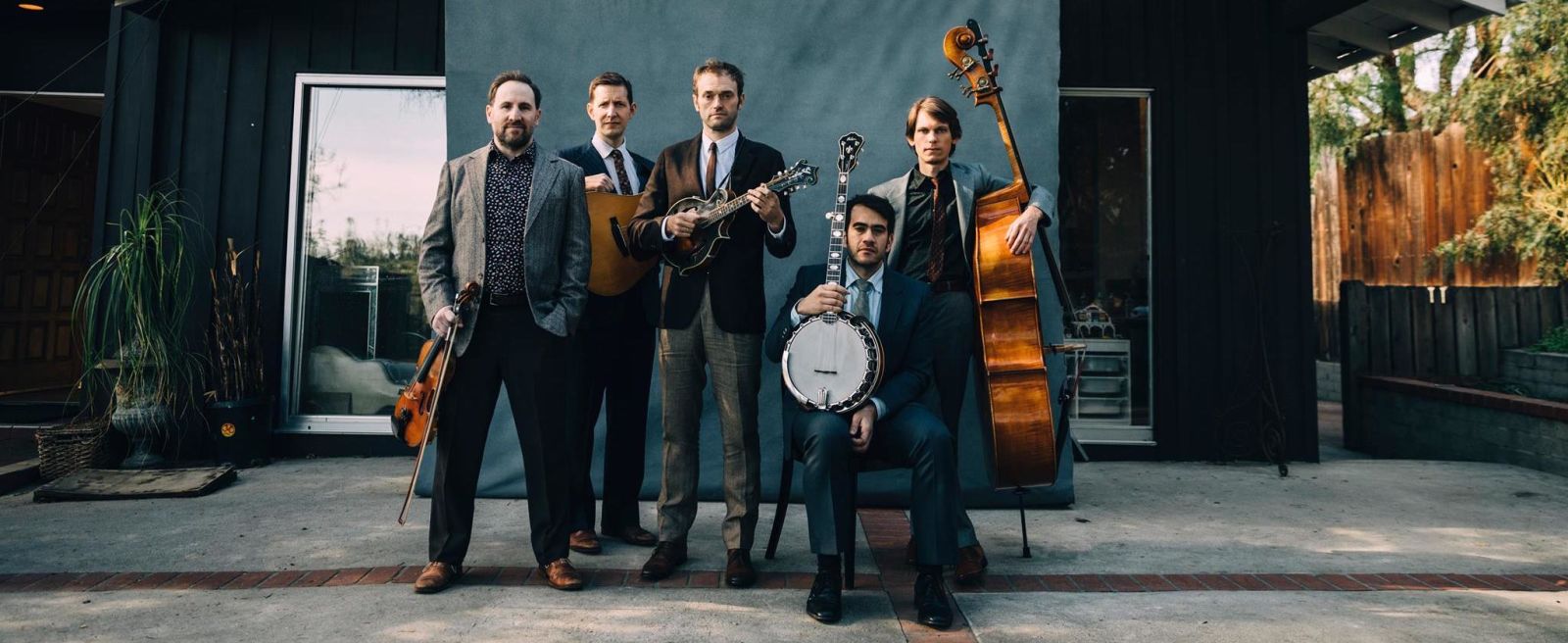
Punch Brothers
FollowNew York, NY
About
All Ashore
, Punch Brothers’ fifth album and the first to be self-produced by the
quintet, is both ambitious and easygoing, a lot like the “ridiculously
eclectic” combo, as London’s Guardian once called the band. The
work has the feel of a nine-song suite, one that invites you to unravel the
threads of its connected themes and stories over repeated listening. Each
track segues seamlessly, even a little sneakily, into the next. Before you
know it, “The Angel of Doubt,” a dark-night-of-the-soul drama featuring a
vocal from singer-mandolinist Chris Thile, has glided into “Three Dots and
a Dash,” an instrumental that veers from ruminative to rave up, named in
tribute to a classic Tiki cocktail, Thile’s latest recreational obsession.
Thile calls All Ashore “a meditation on committed relationships in
the present day, particularly in light of the current unsettled political
climate—certainly the most unsettled one that anyone in the band has ever
experienced.” He continues, “We were hoping we could create a thing that
would be convincing as a complete thought, sort of a nine-movement or a
nine-song thought, even though it’s rangy in terms of what it’s talking
about and in the characters doing the talking.”
When Punch Brothers released its last album, Phosphorescent Blues,
in 2015, Rolling Stone noted, “The genius of Thile and bandmates
guitar player Chris Eldridge, bassist Paul Kowert, banjo player Noam
Pikelny, and fiddler Gabe Witcher is the artistry with which they mix
bluegrass, roots, rock, pop, jazz, and classical to create a unique,
contemporary sound.” All Ashore also has an appealingly relaxed
virtuosity to it, self-assured but never showy.
In a more pronounced way than on prior discs, All Ashore comes
across as a glimpse into Punch Brothers’ current real life, as these
artists who have spent more than a dozen years playing together grapple
with marriage, family, and their ever-accelerating individual careers as
producers, composers, arrangers, and front men. On the album’s early
tracks, it candidly addresses the state of their own world. In smart and
satirical later songs like “Jumbo” and “All Part of The Plan,” it tackles
the state of our collective one. Understated ballad “The Gardener”
poignantly combines the personal and political in its evocation of a
dedicated tradesman who brings beauty to a family’s garden but remains a
stranger, a mysterious other, to them, only glimpsed occasionally from a
window.
The five band members took time from their families to once again come
together United Sound in Los Angeles (formerly Ocean Way), where they’d
previously recorded Phosphorescent Blues with T Bone Burnett as
well as their 2010 album, Antifogmatic. Pikelny says. “When we
first got together as a band, we were mostly single guys in our mid to late
twenties. We shared a musical vision but there was this sense of
fraternity, of brotherhood, that really sealed the deal and laid the
groundwork for a long lasting collaboration.”
He adds, “We had so much more free time than we have now, with fewer family
and professional commitments. Our time together early on would happen
spontaneously, casually, and often included stumbling home from cocktail
bars at 3am in New York. We now have to be much more organized with our
time to make sure we have opportunities to be together and make music.
We’re no longer all living in the same city, three of us are married, and
there are three Punch Brothers kids running around.”
Pikelny continues “On top of that, the current political and cultural
situation in this country really contrasts with anything the five of us
have experienced in our lifetimes. All our previous albums were made in
times of relative calm, compared to the present time. But who better than
your closest musical family to help navigate and makes sense of these
increasingly foreign and challenging times? This album seemed like a
momentous re-gathering of the band, an opportunity to really get to the
core of what Punch Brothers represents. ”
Additionally, the band’s individual projects influenced them on All Ashore. “We were hearing new things out of everyone,” says
violinist Witcher, “and that’s what going off and doing something else does
for you. We had this whole collection of influences, new experiences, a
broadening of scope.”
Thile has always juggled multiple projects throughout his career with Punch
Brothers and as a member of Grammy Award-winning trio Nickel Creek. He
currently hosts the public radio show, Live from Here, often
abetted on stage by one or more Punch Brother. In 2017 alone, he released a
duo album with jazz pianist and Nonesuch labelmate Brad Mehldau; a set of
Bach trios with the cellist Yo-Yo Ma and his longtime mentor and friend,
double bassist Edgar Meyer; and Thanks for Listening, a studio set
of “Song of the Week” tunes he’d composed for Live from Here.
Witcher produced albums for Nickel Creek’s Sara Watkins (2016’sYoung in All the Wrong Ways), Pikelny (his 2017 solo disc, Universal Favorite), and the acoustic guitar duo of Punch Brother
Chris Eldridge and Julian Lage (2017’s Mount Royal). Nonesuch
label mate Rhiannon Giddens recently engaged Witcher to create orchestral
arrangements of her repertoire for concert appearances with symphony
orchestras.
Kowert just released Unless, the debut disc with his
Nashville-based quartet Hawktail produced by bandmate Eldridge and
featuring frequent Live from Here guest star violinist Brittany
Haas. Eldridge also recorded and toured with Julian Lage, a prodigious
guitarist who melds his jazz background with folk, rock and bluegrass. In
early 2017, Pikelny released a purely solo album, Universal Favorite, and toured the country extensively with his
one-man show. He produced Motel Bouquet for singer-songwriter
Caitlin Canty, with whom he also performs. In fall of 2017, he was again
awarded Banjo Player of the Year by the International Bluegrass Music
Association.
For All Ashore, instead of recording a stack of tunes out of which
they would assemble an album, Witcher explains, “We decided we would write
and record this album in sequence. In doing so we were really able to
construct the narrative, musically and lyrically, throughout the whole
process. That was a new way of doing things for us that helped the
cohesiveness and narrative.”
Eldridge adds, “These songs hadn’t been played live
before. They were played for the first time in the studio. When you’re
doing that, you capture something, that moment of discovery—what the tune
is, how it goes, ‘this is how I have to relax into this section of the
tune,’ all these things that are subtle but palpable to the listener and
even to your fellow bandmates as you are discovering them together. I think
we captured that on tape.”
The blend of concentration and cooperation that Thile had to muster for the
arduous “Song of the Week” segment of Live from Here markedly
informed the making of All Ashore, notes Kowert: “Chris’s
compositional chops are in peak form, having worked under constant pressure
for the radio show. And it was a similar experience for all of us, in our
own ways, this openness to incorporate other people’s instincts—combined
with a kind of last-minute element. Thile was always walking to the writing
sessions, to the rehearsals, and to the actual recording—and along the way
he would be working on lyrics for the next week or even the following day.
Some lyrics were written right before takes. He would present his thought
from his walk to the band and we would work on it together. There was a
spontaneity to the results.”
Thile agrees: “They had the confidence and the ability to articulate what
might be bothering them about a particular lyric. Maybe my increased
confidence as lyricist—from the radio show, which is like a compositional
boot camp both musically and lyrically—gives me a level of comfort. It’s a
motivating force. When I would go back to the drawing board, I’d invariably
return with lyrics I was more excited about. That aspect of Punch Brothers
has hit a new level. Whatever we are working on, it’s gotten deeper and
resulted in greater change.”
As Eldridge says, “It feels to me that we are a better band. The irony is
that we have done way less together in the last two years than we’ve ever
done. There is a beautiful familiarity to having this long-term
relationship, and Punch Brothers are a thing that I expect will be a part
of our lives for a long, long time. It’s a lifer band. To have that ongoing
relationship, to have had a decade together, with it comes this sense that
we don’t need to prove anything. We are comfortable enough with what we
are, what we do, to celebrate the things that are cool and unique and
creative about the band. Looking at it from that angle, our only goal was
to make a record that was honest and beautiful.”
“This record is a distillation the things that only we can do,” echoes
Witcher. “We wanted to focus on the things that make us unique, and I think
we did. And we have a more cohesive and successful record. We’ve been
around for twelve years now; we know who we are.”
—Michael Hill